Published 5 November 2026 · By the VoltPoint Battery Service team
Why does my car battery keep dying?
The usual reasons a battery keeps going flat, from dashcams and GPS trackers to short school runs, a failing alternator or a missed registration.
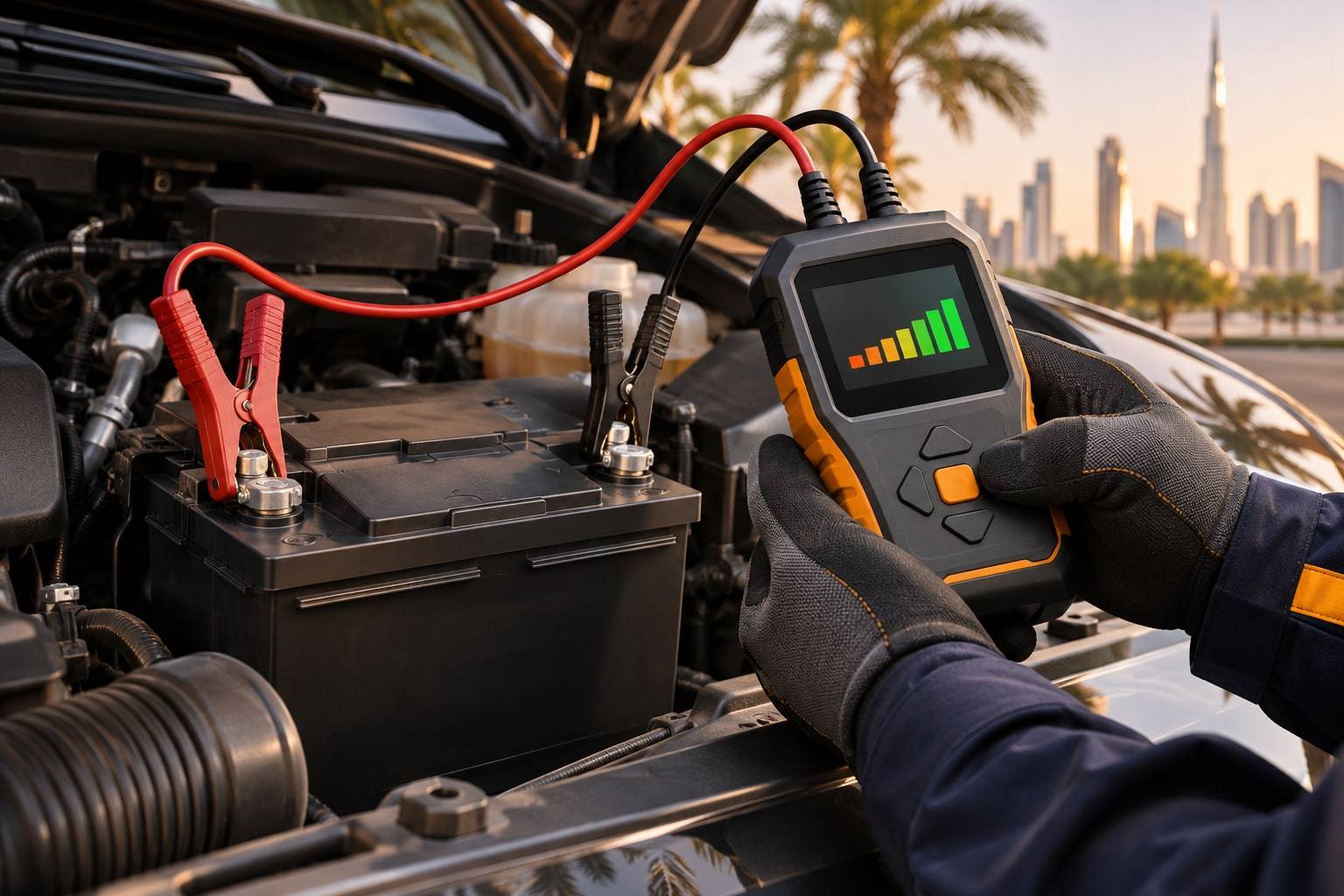
A car battery that keeps dying is either not being charged enough, being drained while the car is parked, or worn out. The most common causes in the UAE are dashcams, GPS trackers and other accessories wired to stay on, short trips with the AC running, a failing alternator, and a battery that has been weakened by heat.
Replacing the battery fixes only the last of these. If the real cause is a drain or a charging fault, the new battery will go flat too. This guide explains how to find the cause.
Common causes at a glance
| Cause | Typical signs | What fixes it |
|---|---|---|
| Old or heat-damaged battery | Slow cranking, battery more than two or three summers old, fails a test | A new battery |
| Accessory drain (dashcam, tracker, alarm) | Flat after a day or two parked, fine when driven daily | Rewiring, a low-voltage cut-off, or removing the accessory |
| Short trips | Flat after a week of school runs or short commutes, better after a long drive | Longer drives or a battery charger |
| Failing alternator | Battery light on, dim lights while driving, dies after a jump start | Alternator repair |
| Wrong battery type | Conventional battery in a start-stop car, early failure, start-stop stops working | The correct EFB or AGM battery |
| No registration after a swap | European car, new battery failing within months | Registering or coding the battery to the car |
| Loose or corroded terminals | Intermittent starting problems, white or green deposits | Cleaning and tightening the terminals |
| Something left on | Boot, glovebox or interior light staying on | Finding and switching it off, or fixing the switch |
What a parasitic drain is
Every modern car uses a small amount of power when it is parked and locked. The clock, the alarm, the keyless entry receiver and the computer memories all need a little current. This is called parasitic drain, and some of it is normal.
When you lock the car, its electronic modules stay awake for a while and then go to sleep. Once they are asleep, a healthy car usually draws only a few tens of milliamps. A healthy battery can supply that for weeks.
A problem starts when something keeps drawing more current than it should, or keeps waking the car up. Then the battery may go flat in days, or even overnight.
Dashcams, trackers and accessories
Aftermarket electronics are a common cause of drain in the UAE, where many cars have a dashcam, a tracker or both.
- Dashcams with parking mode. A hardwired dashcam that records while the car is parked draws power all the time. Most have a low-voltage cut-off, but if it is set too low, or the wiring bypasses it, the camera can flatten the battery.
- GPS trackers. Trackers fitted for insurance, fleet or security use are usually wired to a permanent live feed. A faulty tracker, or one that reports often, can drain a battery over a few days.
- Alarms and remote starters. Poorly installed aftermarket alarms can stop the car from going to sleep.
- Amplifiers, lights and fridges. Sound systems, light bars and cool boxes fitted for desert trips can draw power with the engine off if they are wired to the wrong feed.
- Chargers and plug-in devices. In some cars the 12V sockets stay live when the car is off. A phone charger, air freshener or tyre inflator left plugged in can drain the battery.
If your battery started dying after an accessory was fitted, start there.
Short trips and school runs
Starting the engine takes a large amount of energy from the battery. The alternator then needs time to put it back. On a short trip with the AC on full, the lights, fans and screens use much of the alternator’s output, and the battery may not recover what it lost at start-up.
A week of short school runs, short commutes and stops in between can leave the battery steadily lower each day. In summer, the heat makes this worse. One long drive a week, or a battery charger, helps.
Batteries that keep dying but test good
If a battery has been tested and passed, but keeps going flat, the cause is usually one of these:
- a drain, which the battery test does not measure,
- a charging problem, where the alternator charges too little, or only some of the time,
- a voltage-only check, which only shows the state of charge, not the battery’s health. Our car battery voltage chart explains why voltage alone is not a test,
- a battery that was recharged before testing, which can hide a weak battery for a short time.
A full test checks the battery’s starting power under load, then the charging system with the engine running. Our guide to battery or alternator: how to tell covers the charging side in more detail.
How to test for a drain
A drain test measures how much current the car draws when it is parked and asleep.
- Make sure the battery is fully charged.
- Switch everything off, close the doors and lock the car. Leave the bonnet open with the latch closed so the car thinks it is shut, if your car allows it.
- Connect a multimeter set to measure current in series between the negative battery terminal and the negative cable.
- Wait for the car’s modules to go to sleep. On some cars this takes a few minutes; on others it takes much longer.
- Read the current. If it stays high after the car has gone to sleep, there is a drain.
- To find it, remove fuses one at a time and watch the reading. When the current drops, that circuit holds the fault.
Be careful. Opening a door or pressing the key fob wakes the car and the reading jumps. Never try to start the car with the meter connected; the starting current can damage the meter. On many European cars, disconnecting the battery can reset settings or cause warning messages. If you are not comfortable doing this, ask for a professional test.
The wrong battery for the car
Cars with start-stop need an EFB or AGM battery. A conventional battery in a start-stop car is cycled harder than it was designed for and usually fails early. Cars with brake energy recovery or a battery management system usually need AGM. See AGM vs EFB vs conventional batteries.
On many BMW, Mercedes-Benz, Audi, Volkswagen and Land Rover models, the new battery must also be registered to the car. Without registration, the car keeps charging the new battery as if it were the old, worn one. That can lead to undercharging or overcharging and a short battery life. See battery registration explained.
Heat and age
Heat is the main reason batteries wear out in the UAE. It speeds up corrosion inside the battery, and a battery that has been through two or three summers often cannot hold a full charge any more. It may start the car on a cool morning and fail after a hot day. Our guide to how heat affects car batteries in Dubai explains why.
If you are leaving the car parked for weeks, for example over the summer, read our guide to leaving your car parked in summer.
Getting it tested
Before you buy another battery, find out why the last one went flat. We come to your car anywhere in Dubai and test the battery and the charging system. If the battery has failed, we can replace it with the right type for the car and register it where needed. If the test points to a drain or the alternator, we tell you so you do not pay for a battery that will not fix the problem. See our car battery testing service.
Need help with your battery now?
We come to your car anywhere in our Dubai service area.