Published 5 November 2026 · By the VoltPoint Battery Service team
Leaving your car parked in the UAE for summer: how to look after the battery
Disconnect, use a maintainer or have someone drive it: what each option does, and what to check before you leave and when you return.
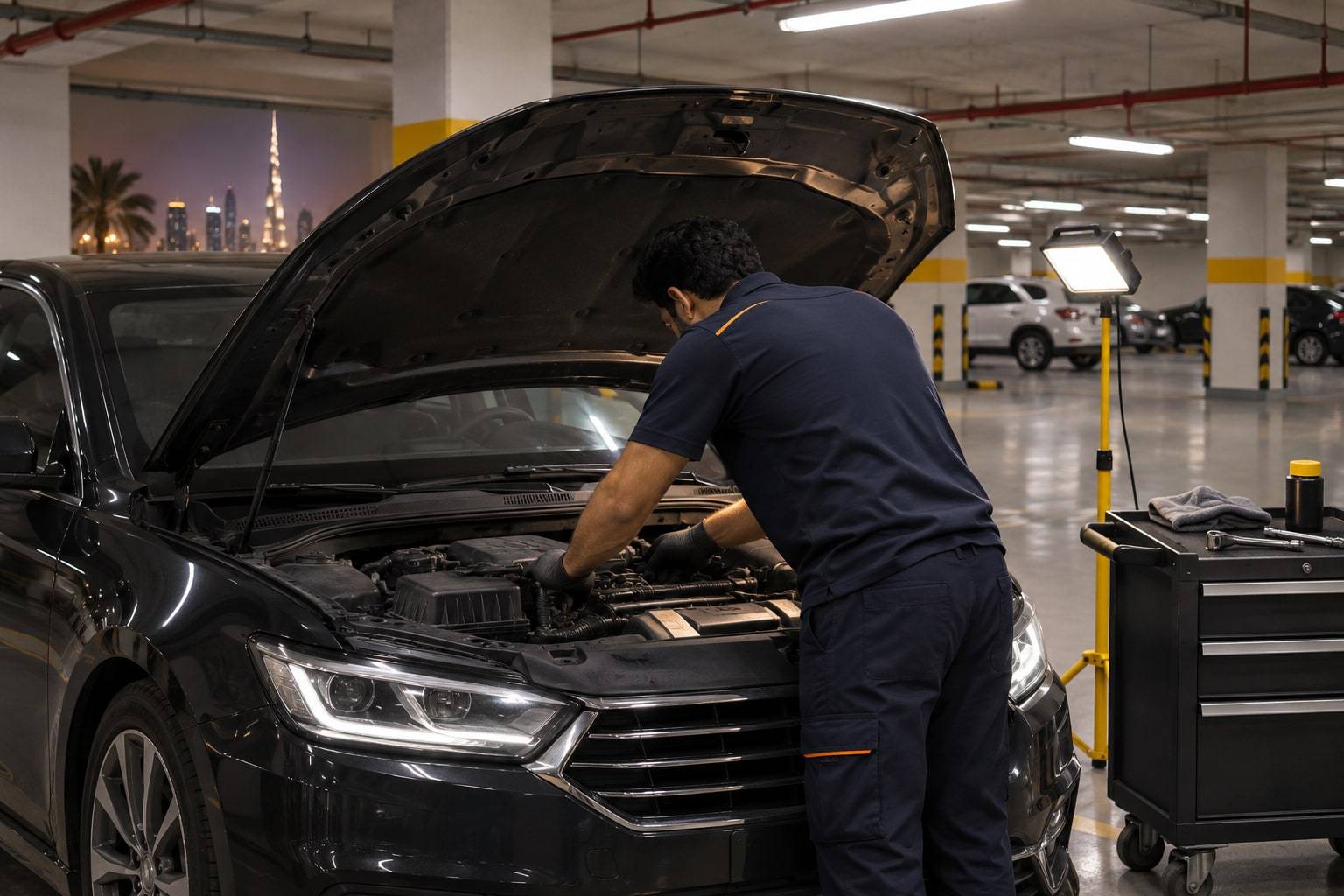
A healthy car battery left parked in UAE summer heat will often be too flat to start the car after three to six weeks, and sometimes sooner on a modern car with an alarm, tracker or dashcam. If you are travelling for July and August, plan for the battery before you leave: disconnect it, fit a maintainer, or arrange for someone to drive the car.
How long can a car battery sit?
There is no single number. It depends on the battery’s age and condition, how much power the car draws while it is locked, and how hot it gets where the car is parked.
Every parked car draws a small current for the alarm, locking, clock and control modules. Many modern cars also wake up regularly to stay connected to the manufacturer’s app. On top of that, a battery loses charge on its own (self-discharge), and heat makes self-discharge faster.
As a rough guide for a parked car in the UAE summer:
| Situation | How long it may sit and still start |
|---|---|
| Newer battery, older car with few electronics, covered parking | Often four to eight weeks |
| Newer battery, modern car with connected services | Often three to five weeks |
| Battery more than two years old | Can be as little as one to three weeks |
| Car with a dashcam on parking mode, GPS tracker or other add-ons | Can be a few days to two weeks |
These are ranges, not promises. A test before you go tells you which group your car is in.
Will a car battery go bad if it is not used?
Yes. A battery that sits flat is damaged, not just empty. When a lead-acid battery stays discharged, sulphate crystals harden on the plates (sulphation). Some of the lost capacity never comes back, even after a full recharge. In heat this happens faster.
So the risk is not only a car that will not start on your return. It is a battery that starts after a jump but has lost much of its capacity, and fails a few weeks later. Our guide to how heat affects car batteries in Dubai explains why summer damage often shows up in October.
Your options before you travel
1. Disconnect the negative terminal
Disconnecting the negative (black, minus) terminal stops the car drawing current. The battery still self-discharges, but much more slowly than with the car connected.
It is a good option for older cars and for long trips. Remove the negative lead and tuck it away so it cannot touch the terminal. Remember that the alarm and central locking will not work, so the car must be parked somewhere secure, and you will need the mechanical key to get in.
2. Use a battery maintainer (smart trickle charger)
A battery maintainer is a small charger that keeps the battery topped up and switches itself to a low float charge when it is full. This is the best option if you have a power socket near the car, such as a villa garage.
Use a smart maintainer, not an old-style trickle charger that charges all the time. A constant trickle can overcharge the battery, and in summer heat that dries it out. If your car has an AGM battery, choose a maintainer with an AGM setting. Most apartment car parks do not have a socket at each bay, so check with your building first.
3. Ask someone to drive the car
A drive of 20 to 30 minutes once a week, at a steady speed rather than in stop-start traffic, keeps the battery charged and the car in better shape generally. Starting the car and leaving it idling for five minutes is not enough. It uses more charge to start than the alternator puts back at idle.
4. Book a test when you get back
Whatever you choose, a battery test on your return tells you whether the battery came through the summer or lost capacity. It is better to find out in your car park than on the road.
What disconnecting does to modern cars
On older cars, disconnecting the battery usually means resetting the clock and the radio presets. On modern cars it can mean more:
- Radio or navigation codes. Some cars ask for a security code after power loss. Find it before you disconnect.
- Windows and sunroof. Auto up and down may stop working until you reset each one (usually by holding the switch up for a few seconds after it closes).
- Idle and throttle relearn. The engine may idle unevenly for the first few drives while the computer relearns.
- Battery monitoring systems. Many European cars track the battery’s state of charge. Disconnecting does not normally cause harm, but a few cars may show warnings or switch off start-stop until they have recalibrated.
- Keyless entry and the alarm. These will not work while the battery is disconnected.
If you are not sure what your car will do, check the owner’s manual or use a maintainer instead. If the battery has been replaced recently, some cars also need the new battery registered with the car, which is a separate step from disconnecting.
Covered versus open parking
Where the car sits matters as much as how long it sits.
| Parking | Effect on the battery |
|---|---|
| Underground or basement parking | Coolest option. Slower self-discharge and less heat damage. |
| Covered or shaded parking | Much better than open sun. The engine bay stays cooler. |
| Open parking in direct sun | Hottest. Engine bay temperatures go well above the air temperature, which speeds up both discharge and permanent damage. |
If you can move the car to a basement or covered bay for the summer, do it.
Checklist before you leave
- Get the battery tested if it is more than two years old or has been slow to start. Replacing a weak battery before you go is easier than dealing with a dead one in August.
- Unplug dashcams set to parking mode, phone chargers and any other add-ons from the power sockets.
- Ask your tracker or insurance company whether a fitted GPS tracker can be put into a low-power mode.
- Park in covered or underground parking if possible.
- Decide on one option: disconnect the negative terminal, fit a maintainer, or arrange weekly drives.
- If you disconnect, note the radio code and keep the mechanical key with you.
- Leave a spare key with someone you trust in case the car needs to be moved or attended to.
Checklist when you get back
- Reconnect the negative terminal if you removed it, and tighten it firmly.
- Start the car and watch for warning lights. A battery or charging light that stays on needs checking.
- Listen to the start. Slow cranking means the battery is low or has lost capacity.
- If it will not start, a jump start can get it going, but treat it as a sign to test the battery, not as a fix.
- Drive for at least 30 minutes to recharge, or put it on a charger.
- Reset windows, the clock and radio presets if needed.
- Book a test within the first week or two, before the battery is relied on for daily use.
Our guide to how long a car battery lasts in the UAE helps you decide whether an older battery is worth keeping after a summer away. Our list of signs your car battery is dying covers what to look out for in the weeks after.
Getting the battery checked
We are a mobile service across Dubai, so the test is done where your car is parked, including basements and building car parks. We test the battery, starter and alternator, and can check for a parasitic drain if the battery went flat faster than expected. Book a car battery test before you travel or when you get back. If the battery needs replacing, we fit the correct type for your car and take the old one away for recycling.
Need help with your battery now?
We come to your car anywhere in our Dubai service area.