Published 5 November 2026 · By the VoltPoint Battery Service team
Car battery voltage chart: what your readings mean
Resting and running voltage charts, how to measure with a multimeter, surface charge, AGM differences, and readings that point to the alternator.
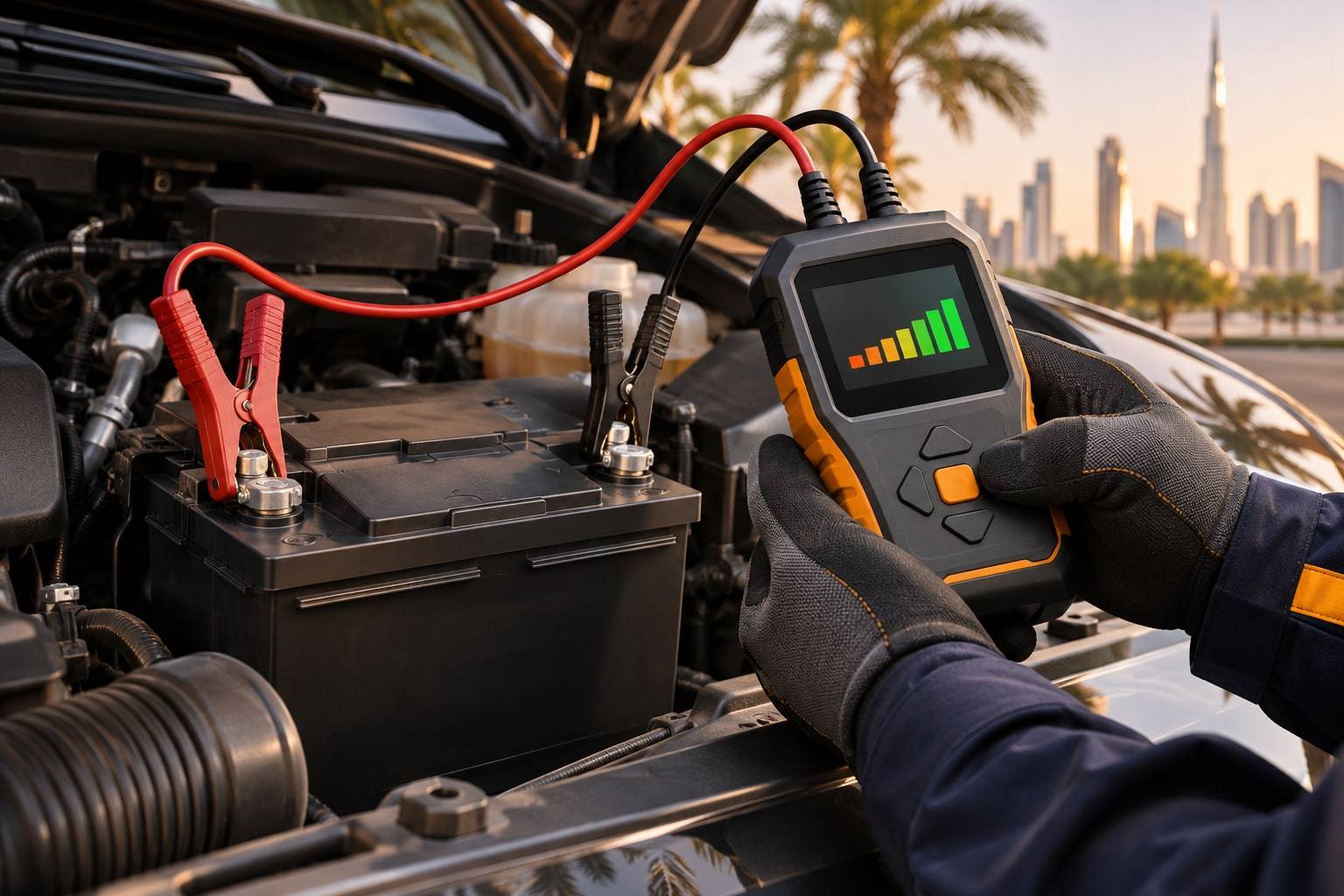
A healthy, fully charged 12V car battery reads about 12.6–12.7V with the engine off and the car rested. With the engine running, the voltage should be about 13.7–14.7V, which shows the alternator is charging the battery.
A reading of 12.2V means the battery is only about half charged. 12.0V or less means it is close to flat. Voltage shows the state of charge, but it does not prove the battery is healthy. That needs a load or CCA test.
Resting voltage chart (engine off)
These figures are for a standard 12V flooded lead-acid battery at rest, at around 25°C. They match the state-of-charge charts published by battery manufacturers. Readings vary slightly by brand and temperature, so treat them as approximate.
| Resting voltage | State of charge | What it means |
|---|---|---|
| 12.6–12.7V | About 100% | Fully charged |
| About 12.4V | About 75% | Usable, but should be recharged |
| About 12.2V | About 50% | Low. Recharge soon; may struggle to start |
| About 12.0V | About 25% | Very low. Likely to fail to start |
| 11.9V or less | Flat | Discharged. Recharge and test |
A battery left below about 12.4V for long periods slowly loses capacity through sulphation. In UAE heat, a battery also discharges faster when the car is parked.
AGM and flooded batteries read differently
AGM batteries read slightly higher at rest than flooded batteries. A fully charged AGM battery reads about 12.8V. Each lower state of charge is also slightly higher than the flooded figures in the table above.
EFB batteries are a type of flooded battery and read close to the standard flooded figures.
If you are not sure what type your car has, check the battery label. For the full comparison, read AGM vs EFB vs conventional car batteries.
Running voltage chart (engine on)
With the engine running, you are measuring the charging system, not the battery.
| Running voltage | What it means |
|---|---|
| 13.7–14.7V | Normal charging |
| Below about 13.2V | Possible undercharging: alternator, belt, wiring or connections |
| Same as resting voltage (about 12.6V or less) | Alternator probably not charging |
| Above about 15V | Possible overcharging: faulty voltage regulator |
Many modern cars, especially European models with start-stop, use smart charging. The car lowers alternator output when the battery is well charged, to save fuel. On these cars a running voltage below 13.7V for a short time can be normal. A diagnostic test gives a clearer answer.
How to measure battery voltage
You need a digital multimeter.
Engine off (resting voltage)
- Switch off the engine and all electrical loads: lights, air conditioning, radio.
- Wait. The car should be rested for at least a few hours, ideally overnight, so the reading is not affected by surface charge (see below).
- Set the multimeter to DC volts, 20V range.
- Touch the red probe to the positive (+) terminal and the black probe to the negative (−) terminal.
- Read the voltage and compare it with the resting voltage chart.
If you are not sure which terminal is which, see our guide to car battery positive and negative terminals.
Engine running (charging voltage)
- Start the engine and let it idle.
- Measure across the terminals again.
- Switch on headlights, air conditioning and the rear demister. The voltage may drop slightly but should stay within the normal charging range.
- Compare with the running voltage chart.
During cranking
If you have a helper, measure while the engine is being started. The voltage normally dips during cranking. On a healthy battery it should stay above about 9.6–10V. A drop much lower suggests the battery cannot deliver enough current.
Stay clear of the fan, belts and other moving parts while the engine is running.
What surface charge is
Straight after driving or charging, a battery shows a higher voltage than its real state of charge. This is surface charge: extra charge held near the surface of the plates that disappears within a few hours.
A battery with surface charge can read 12.8V or more and look full when it is not. To get an accurate reading:
- wait a few hours after driving or charging, or
- switch the headlights on for about a minute with the engine off, switch them off, wait a few minutes, then measure.
Why voltage alone is not a test
Voltage tells you how charged the battery is. It does not tell you how much starting power the battery can still deliver.
A worn battery can read 12.6V and still fail to start the car. Its plates have lost capacity, so the voltage collapses as soon as the starter motor draws current. This is common in the UAE, where heat reduces capacity over time.
A proper test measures:
- Cold cranking amps (CCA), usually by conductance testing, and compares the result with the battery’s rating.
- Voltage under load, which shows whether the battery holds up when current is drawn.
- Charging system output, which checks the alternator.
Readings that point to the alternator, not the battery
| What you see | Likely cause |
|---|---|
| Running voltage about the same as resting voltage | Alternator not charging |
| Running voltage below about 13.2V, with the battery light on | Alternator, belt or wiring fault |
| Running voltage above about 15V | Voltage regulator fault (overcharging) |
| Battery charged and tests well, but goes flat after a few days of driving | Charging fault, or a drain on the battery |
| Car starts after a jump, then dies while driving | Alternator not charging |
A new battery will not fix an alternator fault. It will go flat too. Read battery or alternator: how to tell for more symptoms.
Get a full battery and charging test
A multimeter reading is a useful first check. To know whether the battery needs replacing, it needs a CCA and load test, plus a check of the charging system. We do this on site in Dubai, wherever the car is parked, before recommending any replacement. Book a car battery test.
Need help with your battery now?
We come to your car anywhere in our Dubai service area.